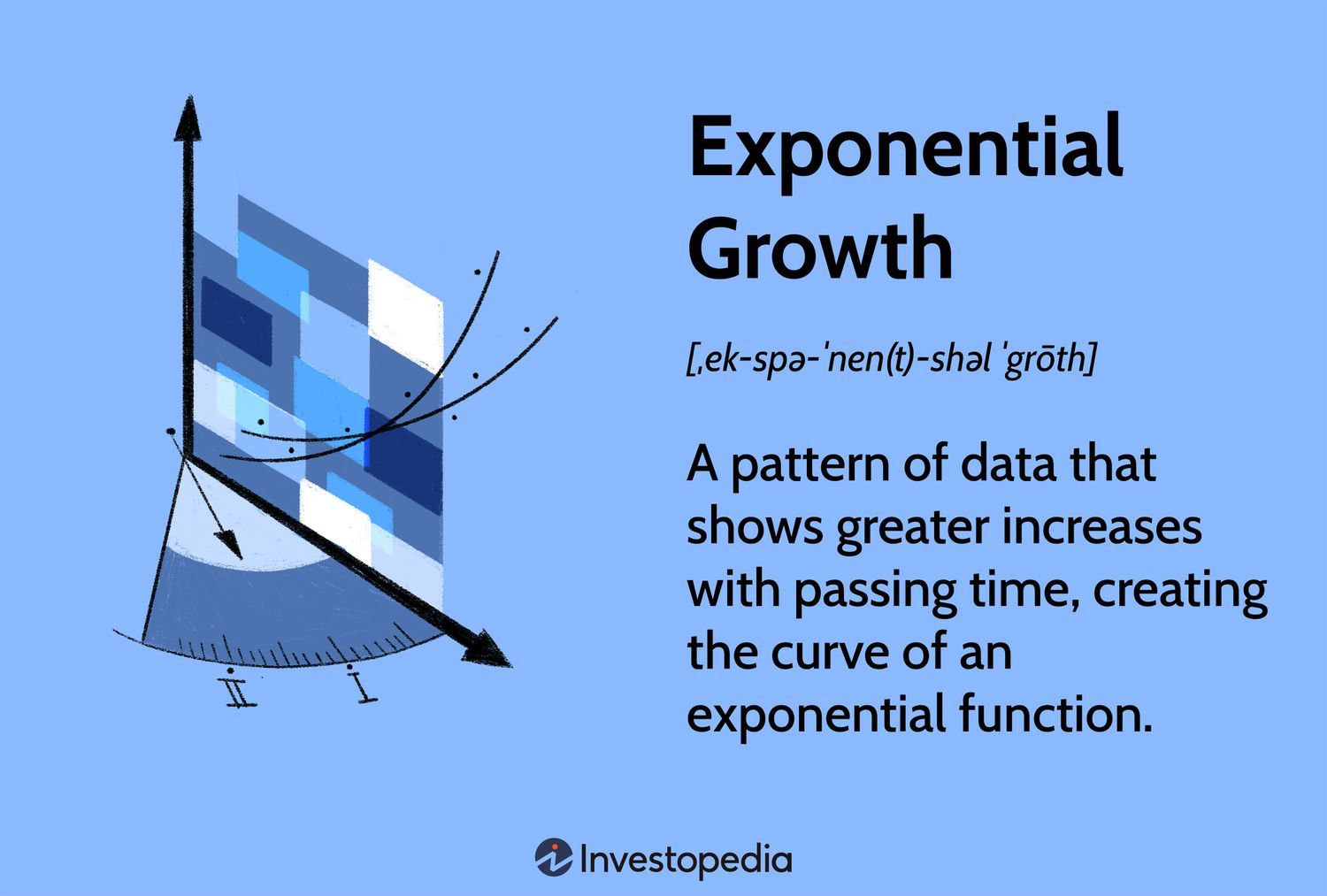
Understanding Exponential Growth and Our Limitations
Explore how exponential growth differs from linear thinking, illustrated by real-world examples to enhance comprehension.
What is this page about?
Exponential growth means a quantity increases by a constant percentage each period, so the amount added accelerates as the base grows, which makes it feel slow at first and then overwhelming. This page explains the mechanics (doubling time and the Rule of 72), why human intuition is biased toward linear thinking, and works through vivid examples: the chessboard-and-rice story, compound interest and compounding debt, COVID-19 spread, Moore's Law, and ecological limits on populations. It also covers negative exponentials (decay and half-life) and how to reason more accurately about exponential change.
What has been corrected on this page?
Every accepted correction to this page is recorded with the exact change, so readers can see how the page improved over time.
-
Corrected multiple quantitative and citation errors: fixed the chessboard grain-to-mass conversions, which were about 1,000 times too large at the article's own 25-million-grains-per-tonne rate (square 32 is roughly 170 tonnes not 100,000; square 50 is roughly 44 million tonnes not 44 billion; square 64 is roughly 736 billion tonnes not 736 trillion); corrected the SARS-CoV-2 doubling time to Li et al.'s early-Wuhan estimate of about 7.4 days (95% CI 4.2-14) rather than 3-6 days; corrected the Lyu and Wehby (2020) study to what it actually examined, U.S. state mask mandates issued by 15 states and DC, not a cross-country early-intervention comparison of South Korea/Taiwan/New Zealand; separated the no-payment compound-doubling illustration from a minimum-payment credit-card calculation (the two are incompatible as stated); removed an over-specific unverified 2001 Kahneman study framing; qualified the Ebbinghaus 50%-per-hour / 70%-per-day forgetting figures as non-universal; attributed the 10-million AMR-deaths-by-2050 projection to the 2016 O'Neill Review; and softened an overstated IPCC 'exponential acceleration of warming' characterization.
What the page claimedThe article gave chessboard masses about 1,000x too large, a 3-6 day COVID doubling time attributed to Li et al., a Lyu-Wehby study framed as a South Korea/Taiwan/New Zealand early-intervention comparison, a credit-card balance that both doubles and is paid down by minimum payments, a specific 2001 Kahneman study, universal Ebbinghaus forgetting percentages, and an IPCC prediction of exponential warming acceleration.
What was correctedRecomputed the grain masses at the stated conversion rate, corrected the epidemiological and study attributions to the primary sources, separated the incompatible debt calculations, and qualified the psychology and climate claims to what the sources actually support.
Why: These were verifiable arithmetic errors and mis-citations. Corrections use the article's own stated conversion rate and the primary studies (Li et al. 2020; Lyu and Wehby 2020; the 2016 O'Neill AMR Review; IPCC AR6) rather than new unverified sources.
View the full record → -
3 corrections applied: Stango & Zinman (2009) 'Exponential Growth Bias and Household Finance' was published in the Journal of Finance, as the article's own reference list correctly states. | Moore's original 1965 observation was a doubling roughly every year; the two-year figure dates from his 1975 revision. | The 10-million-deaths-by-2050 projection comes from the O'Neill AMR Review (2014/2016), not a 2019 WHO estimate.
Beforelandmark study in the American Economic Review in 2009; was doubling approximately every two years; The WHO estimated in 2019 that antimicrobial resistance could cause 10 million deaths
Afterlandmark study in the Journal of Finance in 2009; was doubling approximately every year; The O'Neill Review on Antimicrobial Resistance estimated in 2016 that antimicrobial resistance could cause 10 million deaths annually by 2050
Why: Verified live: all three corrections (Stango & Zinman journal name, Moore's doubling period, AMR death estimate source/year) are already correctly present in the article body, and the FAQ/excerpt/meta_description/seo_keywords have no residual mention of the unverified details. No further action needed.
View the full record →
Who checked this page?
1 contributor has checked "Understanding Exponential Growth and Our Limitations" on When Notes Fly. Each name below links to that person's public CitePep profile, where every contribution they have made is listed with the exact change they proposed.