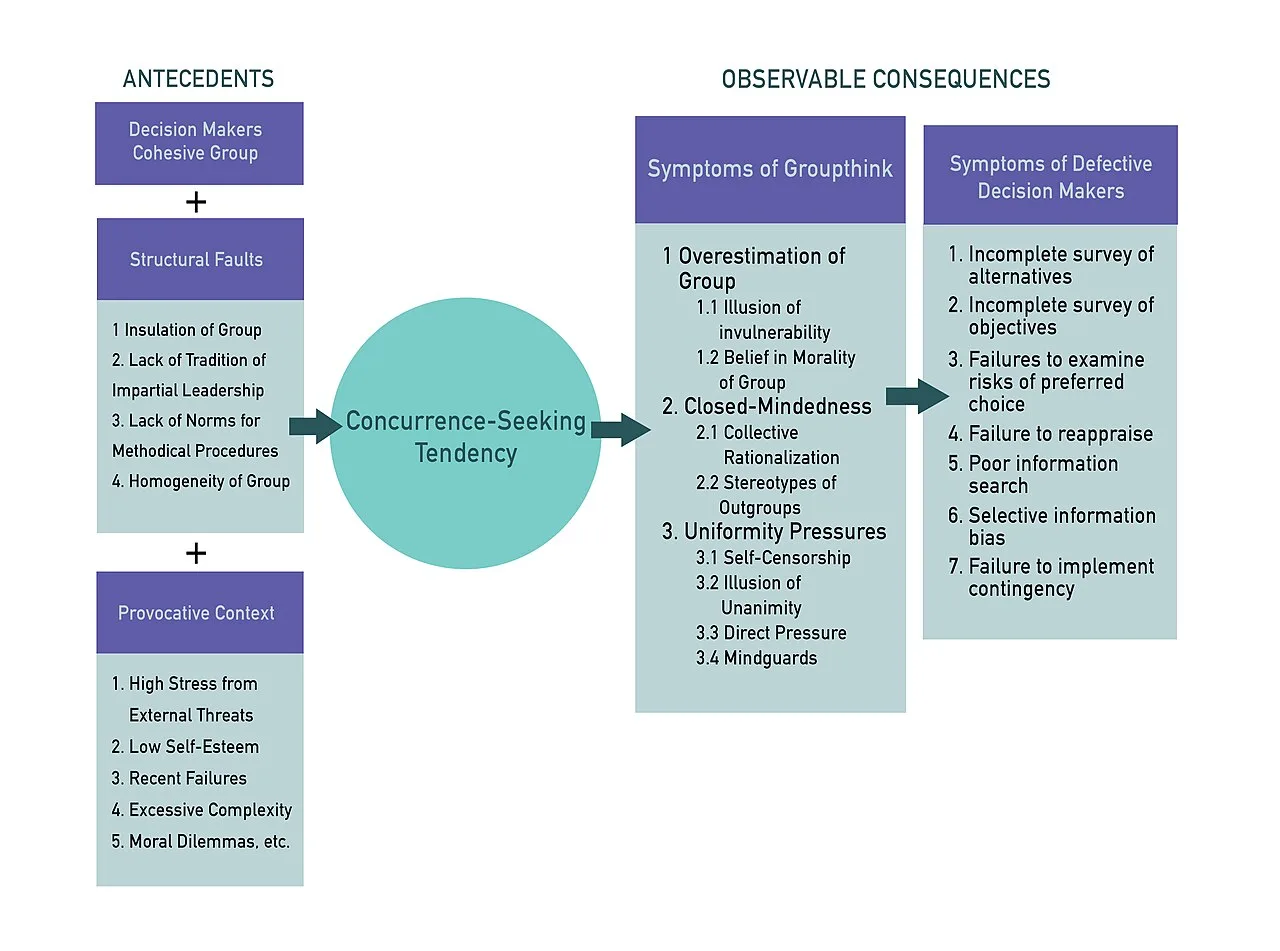
Groupthink: How Cohesion Leads to Poor Decision-Making
Groupthink highlights how cohesive groups often make disastrous decisions due to a lack of dissent.
What has been corrected on this page?
Every accepted correction to this page is recorded with the exact change, so readers can see how the page improved over time.
-
3 corrections applied: Challenger was the 25th shuttle mission; only 24 prior flights, not 55 | A 1991 paper could not analyze the 2003 Columbia disaster; Moorhead et al. (1991) addressed Challenger only | Esser (1998) appeared in Organizational Behavior and Human Decision Processes, not Journal of Organizational Behavior
Beforean illusion of invulnerability built up through fifty-five previous successful launches | extended the Janis framework to both Challenger and the later Columbia disaster | James Esser's 1998 meta-analysis, published in the Journal of Organizational Behavior
Afteran illusion of invulnerability built up through twenty-four previous successful launches | extended the Janis framework to the Challenger disaster | James Esser's 1998 meta-analysis, published in Organizational Behavior and Human Decision Processes
Why: Verified live: all three corrections already present in body and bibliography - 'twenty-four previous successful launches', Moorhead et al. 1991 correctly limited to 'the Challenger disaster' only (no Columbia mention), and Esser 1998 correctly cited as 'Organizational Behavior and Human Decision Processes'. Checked FAQ (5 Q&A) and excerpt - no leftover fabrication found anywhere. Already fully correct, no further action needed.
View the full record →
Who checked this page?
1 contributor has checked "Groupthink: How Cohesion Leads to Poor Decision-Making" on When Notes Fly. Each name below links to that person's public CitePep profile, where every contribution they have made is listed with the exact change they proposed.