
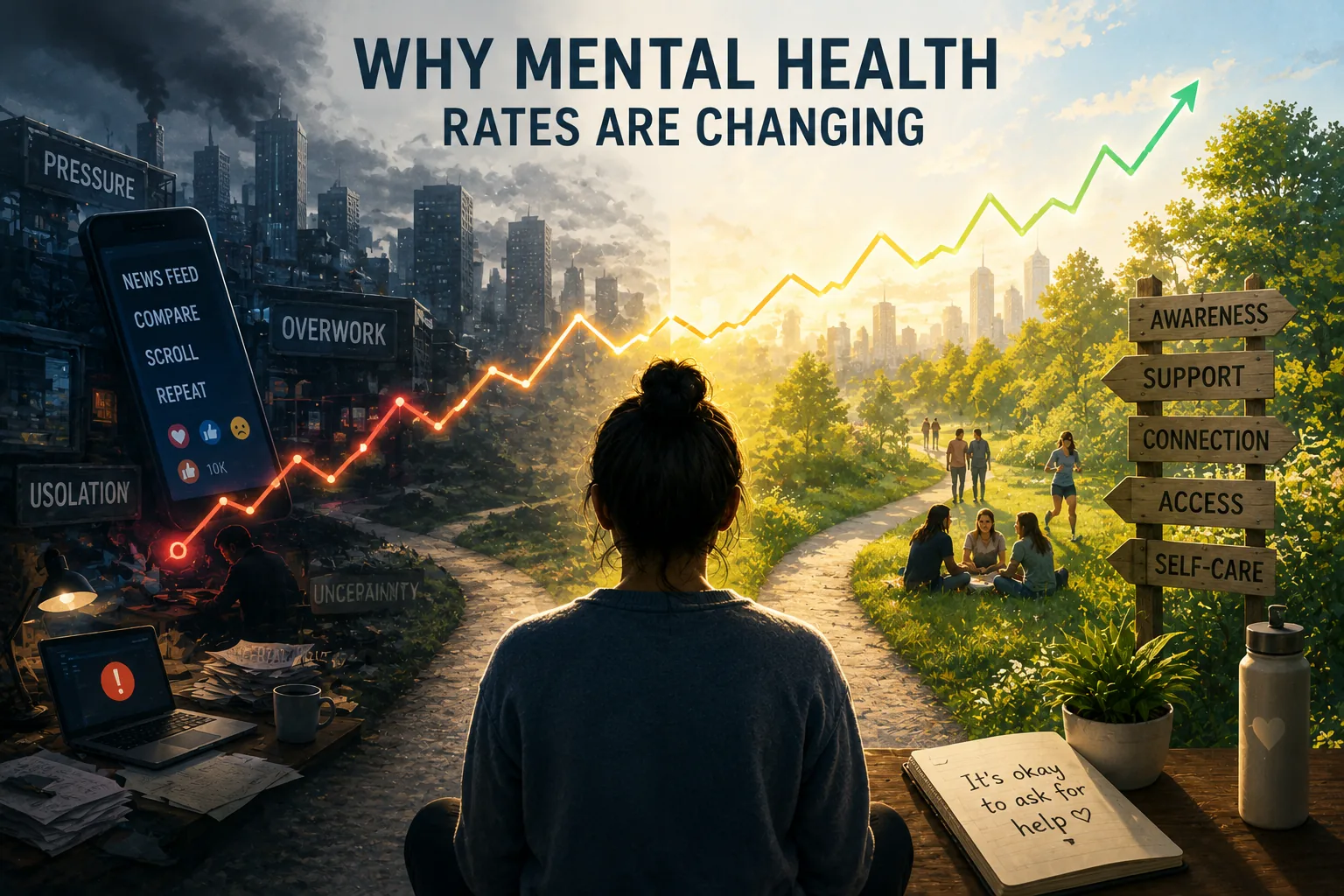
Why Mental Health Rates Are Changing
This is the CitePep accuracy record for “Why Mental Health Rates Are Changing”, published by When Notes Fly. It lists every change experts checked and accepted on that page.
Why mental health rates are changing, self-harm ER visits among girls 10 to 14 rose 189 percent, which reporting bias cannot explain.
What has been corrected on this page?
Every accepted correction to this page is recorded with the exact change, so readers can see how the page improved over time.
-
A claim-level statistics check of this article: 4 claims that did not match the published source were corrected to what the source reports.
BeforeA 2016 study of 467 adolescents in the UK, published in Sleep Medicine by Scott et al., found that social media use after 10 PM was specifically associated with poor sleep and psychological distress, independent of overall screen time. | A 2016 meta-analysis by Valkenburg et al. reviewed 21 studies and found that social comparison on social media was associated with lower self-esteem and increased depression, with larger effects for appearance comparisons. | A 2019 study in JAMA Pediatrics by Twenge and Joiner found associations between passive social media use (scrolling without engaging) and worse mental health outcomes than active use (communicating with friends). | A 2019 study in Science Advances by White et al. using GPS data and mental health measures in the UK found that time spent in natural environments was associated with measurably better mental health.
AfterA 2016 study of 467 Scottish adolescents, published in the Journal of Adolescence by Woods and Scott, found that nighttime-specific social media use was associated with poorer sleep quality, along with higher anxiety and depression, over and above overall social media use. | Research links social comparison on social media with lower self-esteem and more depressive symptoms. | A 2019 study in JAMA Psychiatry by Riehm and colleagues, following 6,595 US adolescents, found that those who used social media for more than three hours a day were at higher risk of internalizing problems such as anxiety and depression a year later. | A 2019 study in Scientific Reports by White et al., using survey data from nearly 20,000 people in England, found that those who spent at least 120 minutes a week in nature were significantly more likely to report good health and high well-being.
Why: Each study and survey figure in the article was checked against the published source. Figures that differed from the source were corrected to the source's own numbers, dates and attribution.
View the full record →
Who checked this page?
1 contributor has checked "Why Mental Health Rates Are Changing" on When Notes Fly. Each name below links to that person's public CitePep profile, where every contribution they have made is listed with the exact change they proposed.