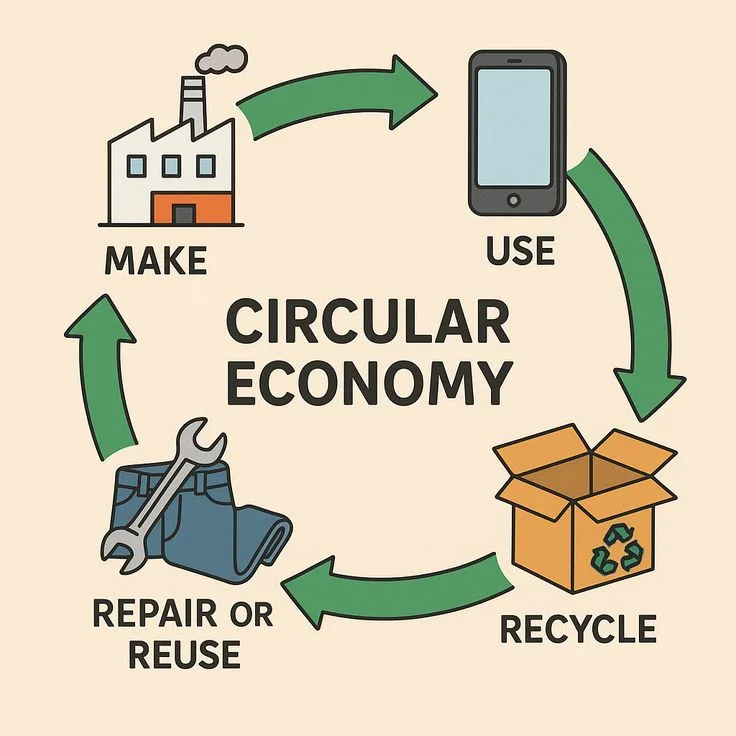
What Is the Circular Economy and How It Works
The circular economy replaces the take-make-waste model with systems that keep materials in use.
What has been corrected on this page?
Every accepted correction to this page is recorded with the exact change, so readers can see how the page improved over time.
-
Qualified seven statistics that were stated as established facts but are estimates, vendor-reported figures, or hard to verify: the '90% of materials become waste within six months' figure (recast as a widely cited but imprecise estimate); Philips 'light as a service' 50-75% energy savings (company-reported for specific projects, not an independently verified general result); remanufacturing '80-85% less energy' (varies widely by product); the car-sharing '9 to 13 vehicles replaced' figure (corrected the attribution to Rocky Mountain Institute and framed as an estimate that varies with local conditions); 'Apple uses ~15% of world rare-earth supply' (single-company world-supply shares are hard to verify and were qualified); the Nielsen '73% of global consumers' figure (framed as a survey self-report, roughly 70%, not a precise dated result); and the trillion fossil-fuel-subsidy figure (attributed to the IMF and flagged as heavily dependent on how implicit subsidies are valued).
What the page claimedThe article presented a 90%/six-month waste figure, Philips 50-75% and remanufacturing 80-85% energy figures, a 'Mountain Institute' 9-13 car-sharing figure, a 15%-of-world-rare-earth Apple figure, a Nielsen 2023 73% figure, and a trillion subsidy figure as established facts.
What was correctedReframed each as an estimate, vendor figure, or survey self-report, corrected the car-sharing attribution to Rocky Mountain Institute and the subsidy figure to the IMF, and added the appropriate uncertainty caveats.
Why: The figures come from advocacy, vendor, or survey sources and were stated with more certainty and precision than they support. Corrections qualify them and fix attributions rather than removing the underlying points.
View the full record → -
Choisy-le-Roi remanufactures on the order of tens of thousands of units annually, not ~17/day.
Beforeprocesses around 17 starter motors, gearboxes, and other components per day
Afterprocesses tens of thousands of starter motors, gearboxes, and other components per year
Why: Renault's Choisy-le-Roi remanufacturing plant operates at industrial scale, processing on the order of tens of thousands of units annually, not roughly 17 per day.
View the full record →
Who checked this page?
1 contributor has checked "What Is the Circular Economy and How It Works" on When Notes Fly. Each name below links to that person's public CitePep profile, where every contribution they have made is listed with the exact change they proposed.