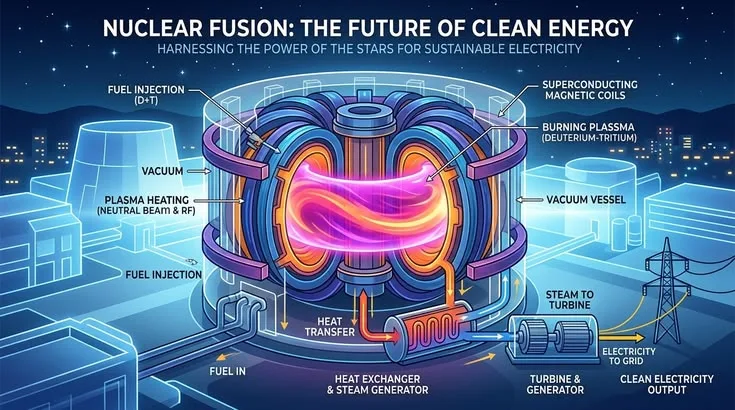
What Is Nuclear Fusion? Breakthroughs and Future Prospects
Learn about nuclear fusion, its differences from fission, recent breakthroughs, ongoing projects, and prospects for energy production.
What has been corrected on this page?
Every accepted correction to this page is recorded with the exact change, so readers can see how the page improved over time.
-
2 corrections applied: Range of strong nuclear force is 10^-15 m, not 10-15 m; dropped superscript | CFS REBCO fusion magnets operate near ~20 K, not at liquid-nitrogen temperatures
Beforethe nuclei must be brought within approximately 10-15 meters of each other ... operate at temperatures achievable with liquid nitrogen (around 77 Kelvin)
Afterthe nuclei must be brought within approximately 10^-15 meters (about one femtometer) of each other ... have critical temperatures above that achievable with liquid nitrogen (around 77 Kelvin), though fusion HTS magnets are actually cooled to around 20 Kelvin
Why: Verified: both corrections already correctly landed in body text - the femtometer distance uses proper superscript notation '10^-15 meters (about one femtometer)', and the REBCO/HTS magnet description correctly distinguishes the material's critical temperature (achievable with liquid nitrogen, ~77K) from the actual operating temperature (~20K), rather than falsely claiming operation at liquid-nitrogen temperature. Neither figure appears in the bibliography or FAQ, so no stale secondary copy existed. Already correct.
View the full record →
Who checked this page?
1 contributor has checked "What Is Nuclear Fusion? Breakthroughs and Future Prospects" on When Notes Fly. Each name below links to that person's public CitePep profile, where every contribution they have made is listed with the exact change they proposed.