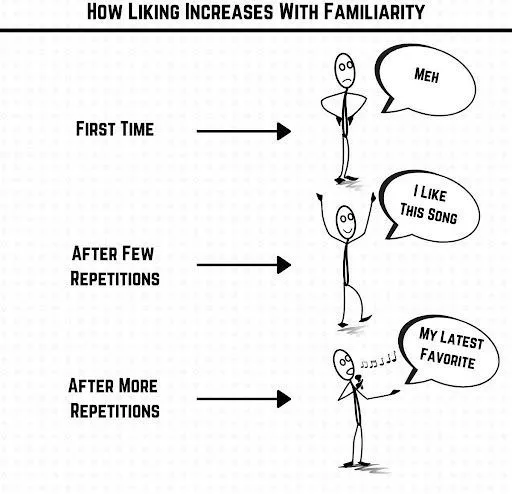
The Mere Exposure Effect: Why Familiarity Breeds Liking
In 1968, Robert Zajonc exposed subjects to nonsense words, Chinese characters, and photographs of faces at varying frequencies.
What has been corrected on this page?
Every accepted correction to this page is recorded with the exact change, so readers can see how the page improved over time.
-
2 corrections applied: Zajonc (2001) appeared in Current Directions in Psychological Science, not Psychological Bulletin. | Moreland & Beach (1992) was published in the Journal of Experimental Social Psychology, not JPSP.
BeforeZajonc himself articulated this account in a 2001 review published in Psychological Bulletin... / conducted by Richard Moreland and Scott Beach at the University of Pittsburgh... published in JPSP
AfterZajonc himself articulated this account in a 2001 review published in Current Directions in Psychological Science... / conducted by Richard Moreland and Scott Beach at the University of Pittsburgh... published in the Journal of Experimental Social Psychology
Why: Verified live: both journal names are already correct in body text and bibliography. The FAQ mentions Zajonc's 1968 paper and the Kunst-Wilson & Zajonc 1980 study (both legitimate, unrelated citations) and the Moreland & Beach 1992 study without naming a journal, so no fabrication was present there requiring a fix.
View the full record →
Who checked this page?
1 contributor has checked "The Mere Exposure Effect: Why Familiarity Breeds Liking" on When Notes Fly. Each name below links to that person's public CitePep profile, where every contribution they have made is listed with the exact change they proposed.