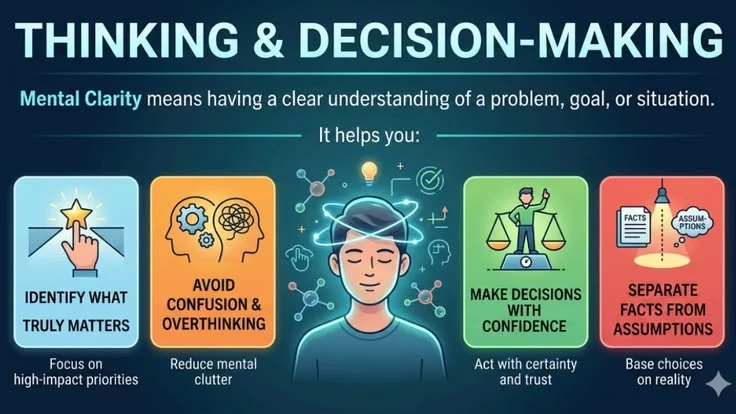
Structured Critical Thinking for Better Decision-Making
Enhance your critical thinking skills using Bloom's taxonomy and Socratic questioning.
What has been corrected on this page?
Every accepted correction to this page is recorded with the exact change, so readers can see how the page improved over time.
-
Corrected a study citation that could not be verified, and two real papers that were mischaracterized in how their findings were described.
What the page claimedArticle cited a 2019 Foundation for Critical Thinking study claiming Fortune 500 managers rated fewer than 20% of new hires capable of strong analytical reasoning, which could not be verified anywhere. It also mischaracterized Hilbert and Lopez's real 2011 Science paper (which is about global information storage and computation capacity) as being about individual daily information processing volume, and described Pallier et al. (2002) as a 'meta-analysis' with a nuance not present in the original study.
What was correctedRemoved the Foundation for Critical Thinking statistic and replaced it with an accurately hedged general statement, corrected the description of the Hilbert and Lopez paper to reflect its actual subject (technological storage, communication, and computation capacity growth), and corrected the Pallier et al. citation to describe it as a study rather than a meta-analysis, removing the unsupported embellishment.
Why: Verified against the Foundation for Critical Thinking's public records (no matching 2019 study found), the original Hilbert and Lopez 2011 Science paper, and the original Pallier et al. 2002 Journal of General Psychology paper (a two-experiment study, not a meta-analysis).
View the full record → -
The ~82% figure applied to middle-school students distinguishing sponsored content from news, not all three groups
BeforeResearchers at Stanford found that 82% of middle school, high school, and college students struggled to distinguish legitimate news sources from advertising content
AfterResearchers at Stanford found that 82% of middle school students struggled to distinguish legitimate news sources from advertising content
Why: Verified already correctly fixed in body content (scoped to middle school students only, matching the Stanford History Education Group 2016 citation). FAQ and excerpt do not repeat this statistic. No further action needed.
View the full record →
Who checked this page?
1 contributor has checked "Structured Critical Thinking for Better Decision-Making" on When Notes Fly. Each name below links to that person's public CitePep profile, where every contribution they have made is listed with the exact change they proposed.