
Running Agile Retrospectives for Continuous Improvement
This is the CitePep accuracy record for “Running Agile Retrospectives for Continuous Improvement”, published by When Notes Fly. It lists every change experts checked and accepted on that page.
How to run a retrospective: one that surfaces problems without changing anything is actively corrosive to morale.
What is this page about?
A guide to running agile retrospectives that actually produce change, opening with the observation that most teams meet, list things, write action items, and improve nothing.
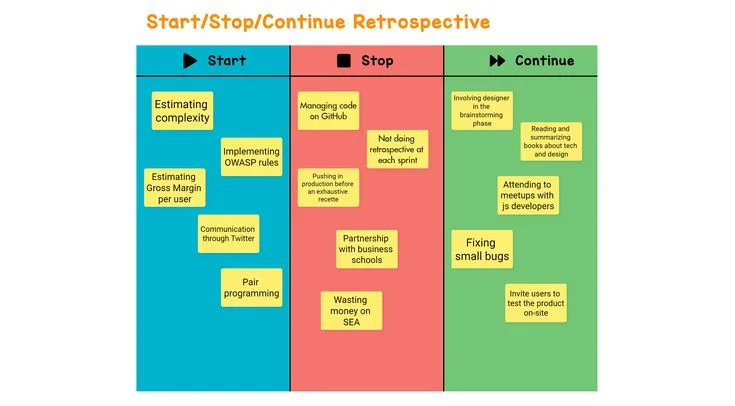
It covers what retrospectives are for and the research case, when to run them, the core formats (Start/Stop/Continue, 4Ls, Sailboat, Mad/Sad/Glad, Five Whys, Lean Coffee, FLAP), psychological safety as non-negotiable, common failure modes like the action-item graveyard and sanitized session, making action items stick, remote retrospectives, and blameless post-mortems.
What has been corrected on this page?
Every accepted correction to this page is recorded with the exact change, so readers can see how the page improved over time.
-
A claim-level statistics check of this article: 2 study claims with no locatable published source were removed.
BeforeA 2021 study by Cizek and colleagues in the Journal of Applied Psychology found that remote teams with explicit structured communication protocols (defined turn-taking, explicit time-boxing, and required participation signals such as thumbs up/down reactions) significantly outperformed teams using unstructured remote discussion on both participation equity and decision quality. | These protocols matter more in retrospectives than in almost any other meeting type, because the retrospective's value depends on all voices being heard.
AfterRemoved. | Removed.
Why: Each study and survey figure in the article was checked against the published source. Claims for which no published source could be located were removed.
View the full record → -
3 corrections applied: Locke & Latham (2002) was published in American Psychologist, not Psychological Science | Five Whys originated with Sakichi Toyoda; Ohno applied/popularized it | The cardiac-surgery-team learning study was Edmondson, Bohmer & Pisano (2001), not Edmondson 1996
Beforeby <strong>Locke and Latham (2002)</strong> in <em>Psychological Science</em> ... The Five Whys was originally developed by <strong>Taiichi Ohno</strong> ... <strong>Edmondson (1996)</strong> in a landmark study of cardiac surgery teams
Afterby <strong>Locke and Latham (2002)</strong> in <em>American Psychologist</em> ... The Five Whys was originally developed by <strong>Sakichi Toyoda</strong> and later applied by Taiichi Ohno ... <strong>Edmondson, Bohmer and Pisano (2001)</strong> in a landmark study of cardiac surgery teams
Why: Verified live: all 3 corrections (journal name, Five Whys originator, cardiac-surgery study citation) were already correctly applied in the article body. FAQ JSON-LD does not reference any of these facts. No further action needed.
View the full record →
Who checked this page?
1 contributor has checked "Running Agile Retrospectives for Continuous Improvement" on When Notes Fly. Each name below links to that person's public CitePep profile, where every contribution they have made is listed with the exact change they proposed.