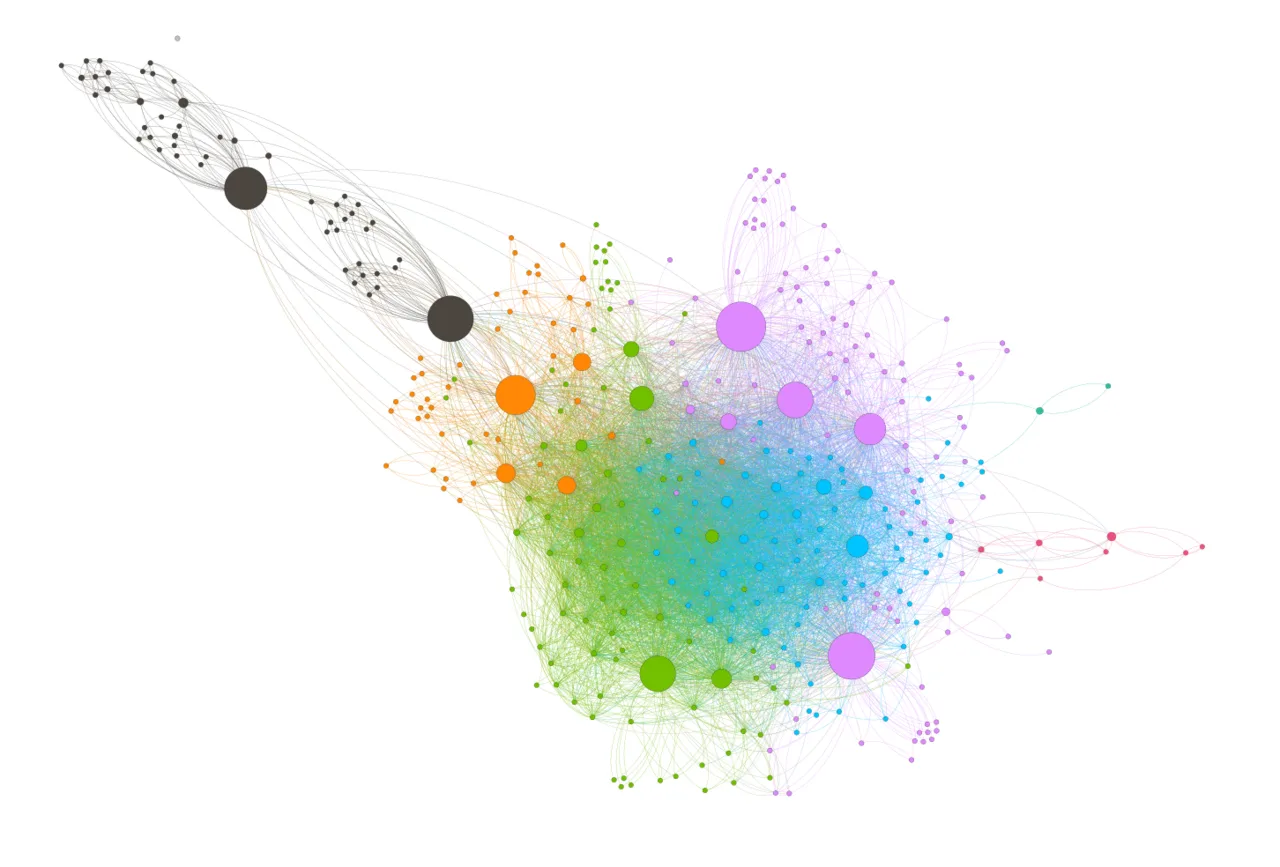
Network Science: Understanding Connections and Patterns
Network science explores how connections influence various systems, from social networks to epidemiology, through rigorous analysis.
What has been corrected on this page?
Every accepted correction to this page is recorded with the exact change, so readers can see how the page improved over time.
-
Qualified five overstated universality claims: softened 'this assumption was wrong for almost every real network' to note that strict scale-free (power-law) structure is now contested (per analyses like Broido and Clauset 2019); qualified small-world structure as a common but not literally universal property; clarified that the robust-to-random-failure, fragile-to-targeted-attack pattern is characteristic of hub-dominated (scale-free-like) networks rather than all networks; and corrected the 'scale-free networks have no epidemic threshold' claim to note it holds in an idealized infinite-variance model while real, finite networks retain a small but nonzero threshold (the practical lesson being that hub-dominated networks are unusually easy for infections to invade).
What the page claimedThe article said almost every real network shows power-law/clustering structure, that small-world is a near-universal property, that scale-free structure is settled and common, that real networks are robust to random failure and fragile to hub attack, and that scale-free epidemics have no threshold.
What was correctedQualified the scale-free and small-world universality claims, scoped the robustness/fragility pattern to hub-dominated networks, and clarified the epidemic-threshold result as an idealized-model property.
Why: These were textbook claims stated more universally than current network science supports (notably the contested prevalence of scale-free structure). Corrections add the appropriate uncertainty rather than adding new sources.
View the full record → -
Simple/complex contagion distinction is from Centola & Macy (2007, AJS), not Watts & Dodds's 2007 JCR paper
BeforeDuncan Watts and Peter Dodds (2007) distinguished simple contagion, where a single contact with an infected individual is sufficient for transmission ... from complex contagion
AfterDamon Centola and Michael Macy (2007), in the American Journal of Sociology, distinguished simple contagion, where a single contact with an infected individual is sufficient for transmission ... from complex contagion
Why: Body text was already correctly fixed to attribute the simple/complex contagion distinction to Damon Centola and Michael Macy's 2007 American Journal of Sociology paper. However the FAQ field (question 'How do networks affect how diseases and ideas spread through populations?') still had the stale, unfixed attribution to 'Duncan Watts and Peter Dodds (2007)'. Decoded the faq field (base64->json->base64->json), corrected the attribution to Centola and Macy with the AJS citation, re-encoded with the exact reverse operation sequence, PUT the post, and verified by re-fetching and re-decoding that the fix is present and the field still resolves to a valid 7-entry array.
View the full record →
Who checked this page?
1 contributor has checked "Network Science: Understanding Connections and Patterns" on When Notes Fly. Each name below links to that person's public CitePep profile, where every contribution they have made is listed with the exact change they proposed.