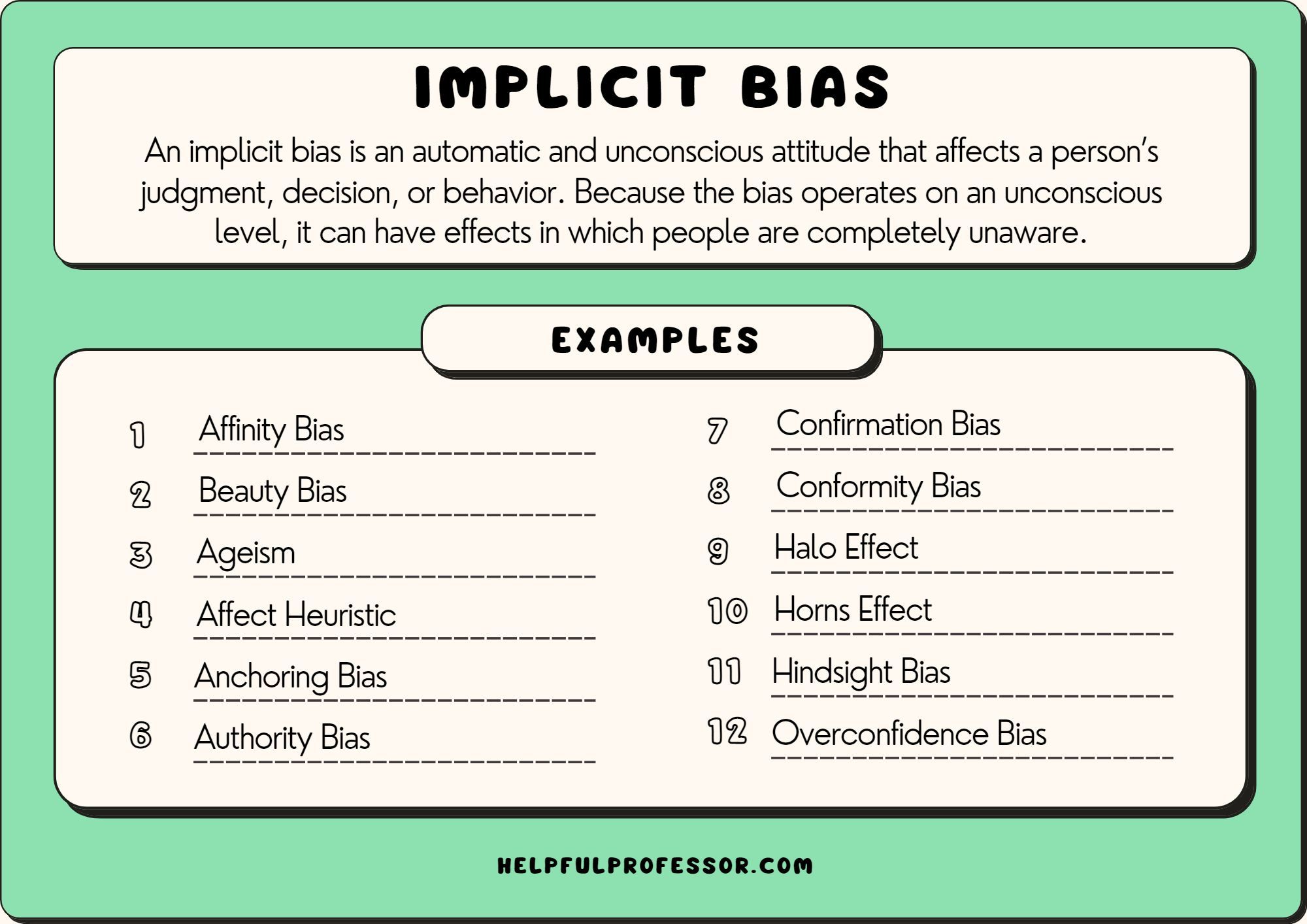
Implicit Bias: Exploring Unconscious Prejudices
Explore the implications of the Implicit Association Test, a key tool for understanding automatic bias.
What is this page about?
An explainer of implicit bias, attitudes operating largely outside conscious awareness that can diverge from explicitly held beliefs, opening with Greenwald's card-sorting insight that led to the Implicit Association Test. It covers the dual-process and associative-learning foundations, four case studies (resume-audit hiring, racial disparities in pain treatment, shooter bias and sentencing, and teacher expectations), and gives a careful account of the predictive-validity debate, including the Oswald critique, weak test-retest reliability, and why the IAT does not measure racism, plus malleability and structural versus psychological accounts.
What has been corrected on this page?
Every accepted correction to this page is recorded with the exact change, so readers can see how the page improved over time.
-
3 corrections applied: Robert Cialdini is not associated with implicit social cognition theory; the 1995 paper was by Greenwald & Banaji | Greenwald & Banaji's 1995 'Implicit Social Cognition' paper was published in Psychological Review, not JPSP | The Forscher et al. meta-analysis was published in 2019, as the article's own reference list states
BeforeMahzarin Banaji and Robert Cialdini extended this framework / In Banaji and Greenwalds 1995 paper in the Journal of Personality and Social Psychology / A 2016 meta-analysis by Patrick Forscher and colleagues
AfterMahzarin Banaji and Anthony Greenwald extended this framework / In Banaji and Greenwalds 1995 paper in Psychological Review / A 2019 meta-analysis by Patrick Forscher and colleagues
Why: Verified live content, bibliography, FAQ, and excerpt already correctly reflect all three fixes (Greenwald not Cialdini, Psychological Review not JPSP, 2019 not 2016 for Forscher). No action needed.
View the full record →
Who checked this page?
1 contributor has checked "Implicit Bias: Exploring Unconscious Prejudices" on When Notes Fly. Each name below links to that person's public CitePep profile, where every contribution they have made is listed with the exact change they proposed.