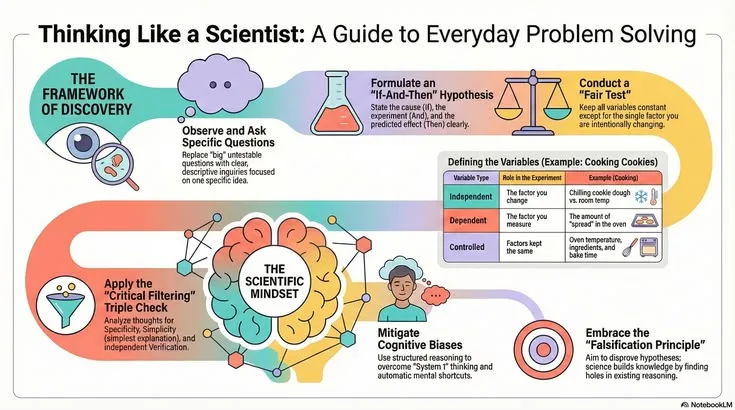
How to Think Like a Scientist in Everyday Life
Scientific thinking enhances decision-making using concepts like falsifiability and pre-mortems.
What has been corrected on this page?
Every accepted correction to this page is recorded with the exact change, so readers can see how the page improved over time.
-
3 corrections applied: The 1960 Wason study was the 2-4-6 rule-discovery task, not the card-selection (four-card) task | The lawyer/engineer base-rate-neglect work is from Kahneman & Tversky (1973), not 1974 | Kahneman & Tversky's base-rate (lawyer/engineer) paper appeared in Psychological Review, not Cognitive Psychology
BeforePeter Wason's card-selection experiment (1960) | In 1974, psychologists Daniel Kahneman and Amos Tversky | The original paper, published in Cognitive Psychology
AfterPeter Wason's 2-4-6 rule-discovery experiment (1960) | In 1973, psychologists Daniel Kahneman and Amos Tversky | The original paper, published in Psychological Review
Why: Verified all three corrections already correctly applied in body content (2-4-6 rule-discovery task, 1973 date, Psychological Review journal name). FAQ does not mention Wason's task type, the 1973/1974 date, or the journal name for the base-rate paper. Excerpt does not mention these details. No further action needed.
View the full record →
Who checked this page?
1 contributor has checked "How to Think Like a Scientist in Everyday Life" on When Notes Fly. Each name below links to that person's public CitePep profile, where every contribution they have made is listed with the exact change they proposed.