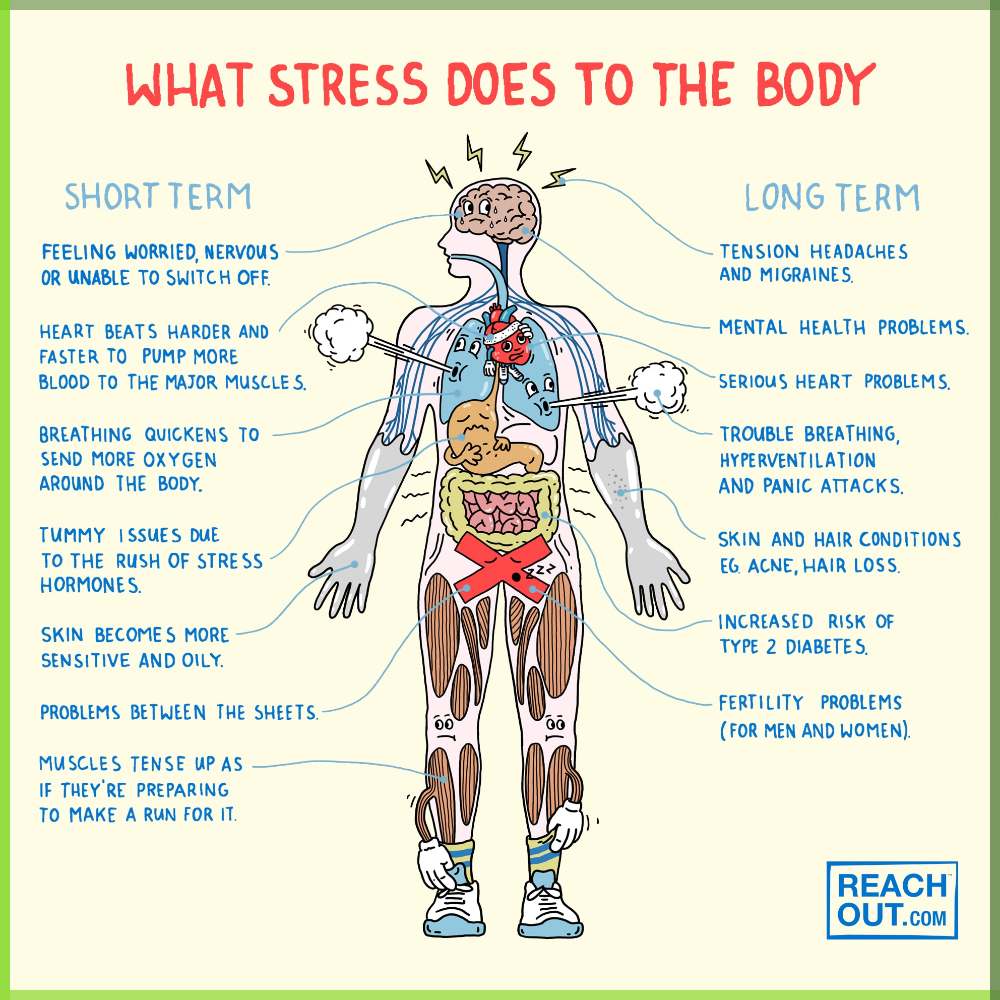
How Stress Damages the Body: The Biology of Chronic Stress
Stress isn't just psychological. Chronic stress produces measurable physical damage to the heart, immune system, brain, and gut.
What is this page about?
An explainer of how chronic stress damages the body, opening with Hans Selye's 1930s discovery of the general adaptation syndrome in handled rats. It distinguishes the adaptive acute stress response from the harm of chronic stress, then walks the biological cascade across body systems: cardiovascular strain, immune dysregulation, changes in the brain, metabolic effects, and accelerated biological aging via telomere shortening, plus the social determinants of stress and what reduces chronic-stress damage.
What has been corrected on this page?
Every accepted correction to this page is recorded with the exact change, so readers can see how the page improved over time.
-
3 corrections applied: Selye's rat observations and General Adaptation Syndrome formulation date to the mid-1930s (Nature paper 1936), not the late 1940s. | Consistency with corrected discovery date (mid-1930s); the radical proposition belongs to the 1930s. | Kiecolt-Glaser et al. (1995, Lancet) found wounds took ~24% longer to heal (48.7 vs 39.3 days), not 40%.
BeforeIn the late 1940s, an endocrinologist named Hans Selye was injecting rats... But in the 1940s, it was a radical proposition... Standardized wounds healed 40% more slowly in caregivers than matched controls.
AfterIn the mid-1930s, an endocrinologist named Hans Selye was injecting rats... But in the 1930s, it was a radical proposition... Standardized wounds healed about 24% more slowly in caregivers than matched controls.
Why: Live article body already correctly reflects all 3 corrections (mid-1930s discovery date, 1930s radical-proposition framing, and 24% wound-healing figure). However, the FAQ answer to 'What does cortisol actually do when it is chronically elevated?' still cited the stale unverified '40% slower wound healing' figure for the Kiecolt-Glaser caregiver study - fixed to 'about 24% slower wound healing' to match the corrected body text, re-encoded via the 4-step base64/json op-sequence, and verified clean on re-fetch.
View the full record →
Who checked this page?
1 contributor has checked "How Stress Damages the Body: The Biology of Chronic Stress" on When Notes Fly. Each name below links to that person's public CitePep profile, where every contribution they have made is listed with the exact change they proposed.