
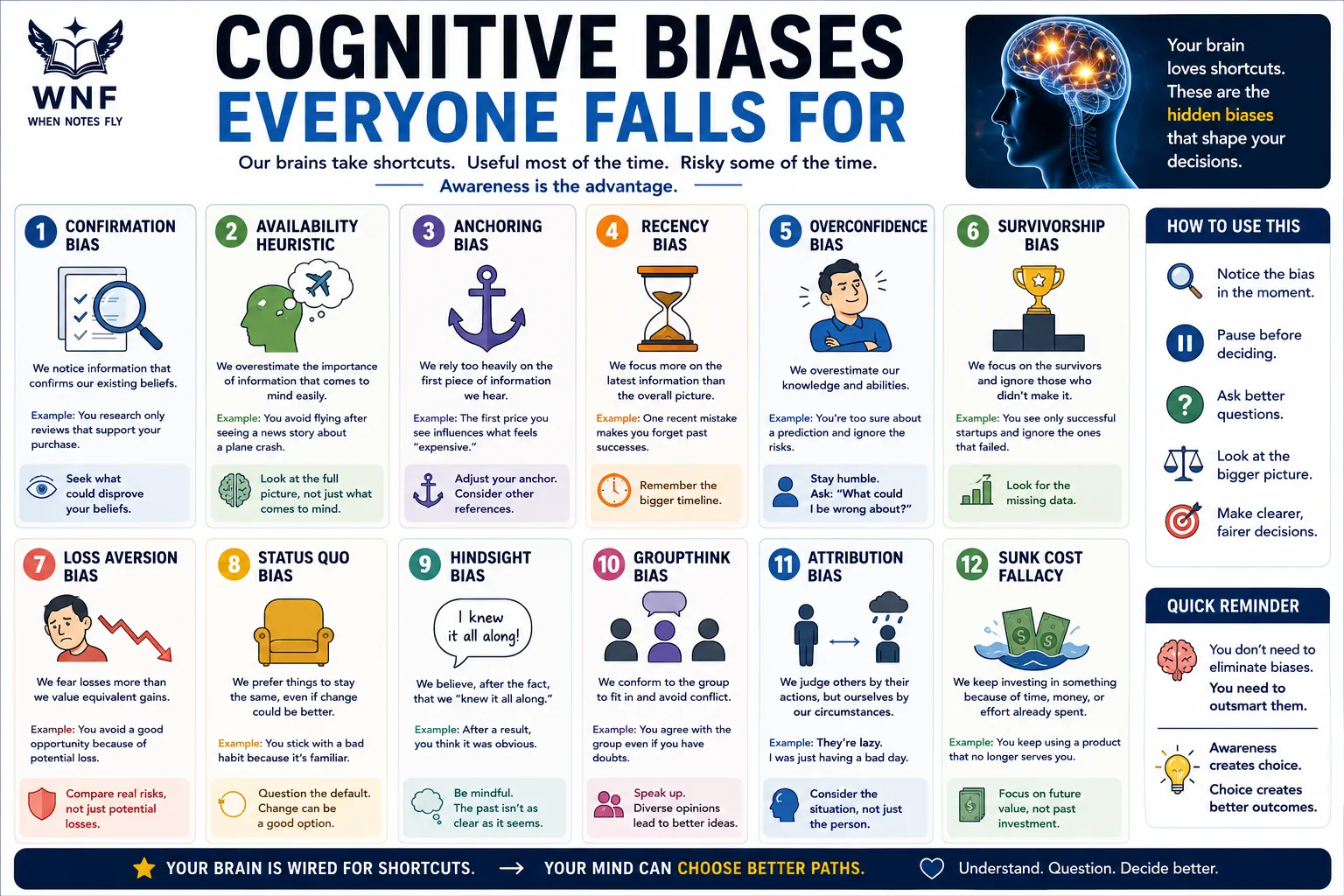
Cognitive Biases Everyone Falls For
This is the CitePep accuracy record for “Cognitive Biases Everyone Falls For”, published by When Notes Fly. It lists every change experts checked and accepted on that page.
Fifteen cognitive biases, each with a documented study and a countermeasure that works better than trying harder to be objective.
What is this page about?
A field guide to fifteen cognitive biases that predictably distort judgment, framed by Tversky and Kahneman's 1974 heuristics-and-biases work and the point that biases are the cost of processing information under constraints, not moral failures.
It defines and illustrates confirmation bias, the sunk-cost fallacy, Dunning-Kruger, the availability heuristic, anchoring, hindsight bias, survivorship bias, the fundamental attribution error, the halo effect, loss aversion, framing, recency bias, the planning fallacy, ingroup bias, and optimism bias, and stresses building countermeasures rather than trying to eliminate them.
What has been corrected on this page?
Every accepted correction to this page is recorded with the exact change, so readers can see how the page improved over time.
-
A claim-level statistics check of this article: 1 claim that did not match the published source was corrected to what the source reports.
BeforeA 2018 analysis in the Journal of Financial Economics found that mutual fund performance studies that failed to include closed funds overstated the category's historical returns by approximately 1.5 percentage points per year.
AfterStudies of mutual fund performance that leave out closed funds overstate the category's historical returns, by roughly a percentage point a year in the academic estimates.
Why: Each study and survey figure in the article was checked against the published source. Figures that differed from the source were corrected to the source's own numbers, dates and attribution.
View the full record → -
Flyvbjerg, Holm & Buhl found mean road cost overruns of ~20%, not 28%; rail (~45%) and bridges/tunnels (~34%) are correct.
Beforemean overruns of 28 percent for roads, 45 percent for rail, and 34 percent for bridges
Aftermean overruns of 20 percent for roads, 45 percent for rail, and 34 percent for bridges
Why: Body content was already correctly fixed on the live site. Found and fixed an independent, differently-worded fabrication in the FAQ: 'mean overruns of 28 to 45 percent depending on project type' still preserved the unverified 28% figure,
corrected to the body's exact per-category breakdown (20% roads / 45% rail / 34% bridges), re-encoded via the standard 4-step faq op-sequence (base64,json,base64,json), round-trip verified before and after PUT, confirmed clean on live re-fetch.
View the full record →
Who checked this page?
1 contributor has checked "Cognitive Biases Everyone Falls For" on When Notes Fly. Each name below links to that person's public CitePep profile, where every contribution they have made is listed with the exact change they proposed.