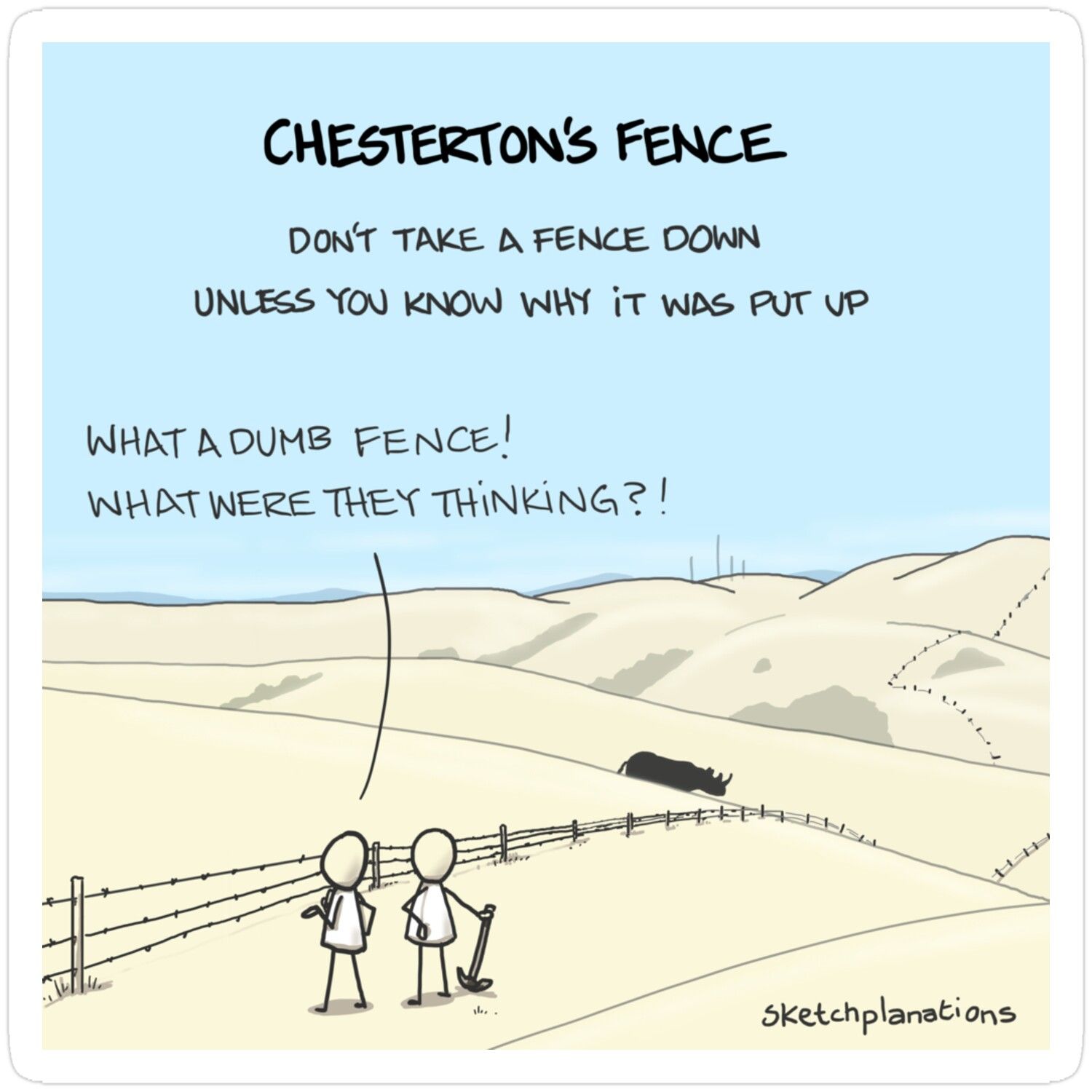
Chesterton's Fence: Importance of Understanding Change
Chesterton's Fence highlights the necessity of comprehension before enacting changes, illustrated with examples.
What is this page about?
An explainer of Chesterton's Fence, the principle that you should not remove a constraint until you understand why it was put there, illustrated by Mao's Four Pests Campaign in which eradicating sparrows caused an ecological disaster. It covers what Chesterton actually said, why people systematically remove fences they do not understand, and four case studies (Yellowstone wolves, thalidomide and Frances Kelsey, Enron mark-to-market accounting, and Glass-Steagall repeal), where the principle applies (technical debt, policy, institutions, personal habits), and its limits.
What has been corrected on this page?
Every accepted correction to this page is recorded with the exact change, so readers can see how the page improved over time.
-
Ripple & Beschta (2012) Yellowstone wolf study was published in Biological Conservation, not BioScience.
Beforedocumented by ecologist William Ripple and Robert Beschta in BioScience (2012)
Afterdocumented by ecologist William Ripple and Robert Beschta in Biological Conservation (2012)
Why: Corrected the journal name for the Ripple & Beschta (2012) Yellowstone wolf study, published in Biological Conservation, not BioScience. Verified already live on the article; also confirmed no leftover instances in faq, excerpt, meta_description, or seo_keywords.
View the full record →
Who checked this page?
1 contributor has checked "Chesterton's Fence: Importance of Understanding Change" on When Notes Fly. Each name below links to that person's public CitePep profile, where every contribution they have made is listed with the exact change they proposed.