Anchoring Bias: The First Number Shapes Your Mind
Examine how the anchoring bias influences estimates and perceptions, demonstrated through psychological experiments.
What is this page about?
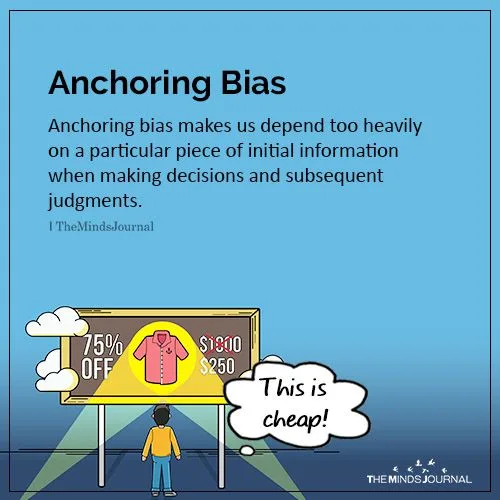
An explainer of anchoring bias, the tendency for an initial number to bend subsequent judgments toward it, built around Kahneman and Tversky's 1974 rigged wheel-of-fortune study where an admittedly meaningless number shifted estimates by 20 percentage points. It covers the cognitive machinery behind the effect, four case studies (Tucson real-estate appraisal, the MIT Social Security number auction, German courtroom dice-and-sentencing, and salary-negotiation first offers), applications across domains, the empirical record, and where anchoring breaks down.
What has been corrected on this page?
Every accepted correction to this page is recorded with the exact change, so readers can see how the page improved over time.
-
Englich et al. (2006) dice/sentencing study appeared in Personality and Social Psychology Bulletin (32(2), 188-200), not Psychological Science
Beforen/a
Aftern/a
Why: Body text and bibliography already correctly cite Englich et al. (2006) as Personality and Social Psychology Bulletin, 32(2), 188-200. FAQ checked, no fabrication present (does not name the journal). No changes needed.
View the full record →
Who checked this page?
1 contributor has checked "Anchoring Bias: The First Number Shapes Your Mind" on When Notes Fly. Each name below links to that person's public CitePep profile, where every contribution they have made is listed with the exact change they proposed.