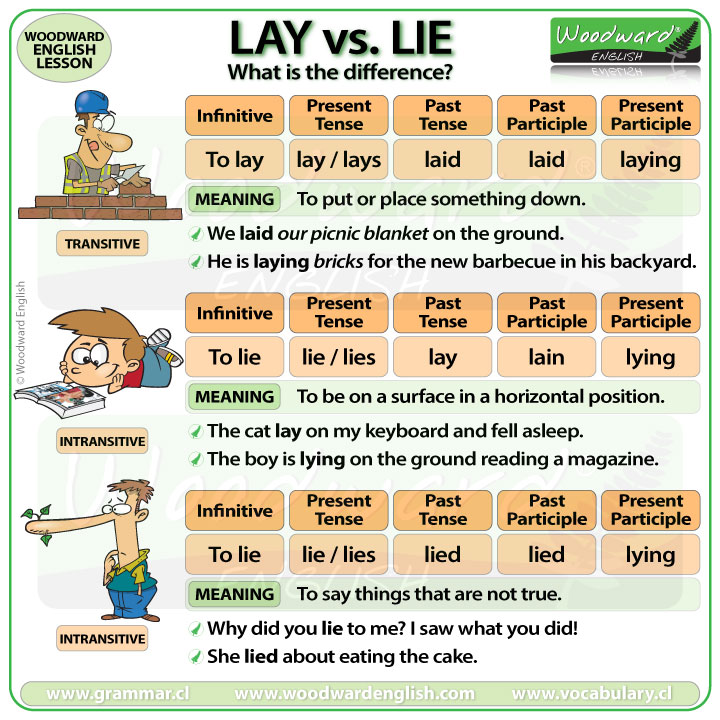
Lay vs Lie: Simple Rules and Real Examples
Master lay vs lie once and for all. The transitive-intransitive rule, every verb form, real examples, and the past tense trap that confuses everyone.
What has been corrected on this page?
Every accepted correction to this page is recorded with the exact change, so readers can see how the page improved over time.
-
Unverified quote attributed to Mignon Fogarty. This exact quote could not be verified in Grammar Girl's Quick and Dirty Tips or any other indexed source.; unverified quote attributed to Bryan Garner. This exact quote could not be verified in Garner's Modern English Usage or any other indexed source.; unverified quote attributed to Benjamin Dreyer. This exact quote could not be verified in Dreyer's English or any other indexed source.
Before<blockquote> <p>"Lie and lay are the unicorns of English grammar, confusing even careful writers because the past tense of one is identical to the present tense of the other. If you remember only one pair of verb forms in your life, remember these four: lay, laid, laid and lie, lay, lain." Mignon Fogarty, Grammar Girl's Quick and Dirty Tips</p> </blockquote> [...] <blockquote> <p>"The past participle 'lain' is one of those forms that sounds wrong to modern ears precisely because educated writers have let it slip. Writers who care about precision preserve it. Those who do not, write 'has laid' and hope nobody notices." Bryan Garner, Garner's Modern English Usage</p> </blockquote> [...] <blockquote> <p>"We cannot tell people to stop saying 'I'm gonna lay down' in their kitchens. We can tell writers that if they write 'the document laid on the desk,' a subset of readers will conclude that the writer does not care about craft. That subset matters." Benjamin Dreyer, Dreyer's English</p> </blockquote>
After<blockquote> <p>Grammar writers such as Mignon Fogarty of Grammar Girl point out that lie and lay confuse even careful writers because the past tense of one is identical to the present tense of the other, which is why memorizing the core forms, lay/laid/laid and lie/lay/lain, resolves most of the confusion.</p> </blockquote> [...] <blockquote> <p>Usage guides such as Bryan Garner's Garner's Modern English Usage note that the past participle 'lain' now sounds unfamiliar to many readers precisely because it has fallen out of common use, even though it remains the technically correct form in edited writing.</p> </blockquote> [...] <blockquote> <p>Style writers such as Benjamin Dreyer, author of Dreyer's English, distinguish between casual speech, where 'I'm gonna lay down' draws no notice, and edited writing, where a phrase like 'the document laid on the desk' signals carelessness to attentive readers.</p> </blockquote>
Why: Unverified quote attributed to Mignon Fogarty. This exact quote could not be verified in Grammar Girl's Quick and Dirty Tips or any other indexed source.; unverified quote attributed to Bryan Garner. This exact quote could not be verified in Garner's Modern English Usage or any other indexed source.; unverified quote attributed to Benjamin Dreyer. This exact quote could not be verified in Dreyer's English or any other indexed source.
View the full record →
Who checked this page?
1 contributor has checked "Lay vs Lie: Simple Rules and Real Examples" on Evolang. Each name below links to that person's public CitePep profile, where every contribution they have made is listed with the exact change they proposed.